OSCE in MBBS: What Medical Students Should Know About Practical Clinical Exams
October 5, 2026 2026-10-09 15:20OSCE in MBBS: What Medical Students Should Know About Practical Clinical Exams
OSCE in MBBS: What Medical Students Should Know About Practical Clinical Exams
Medical education involves much more than learning facts from textbooks. During MBBS, students gradually develop the ability to communicate with patients, take medical histories, perform clinical examinations, interpret investigations, demonstrate procedures, and apply theoretical knowledge to real clinical situations.
One examination format that brings many of these skills together is the Objective Structured Clinical Examination (OSCE).
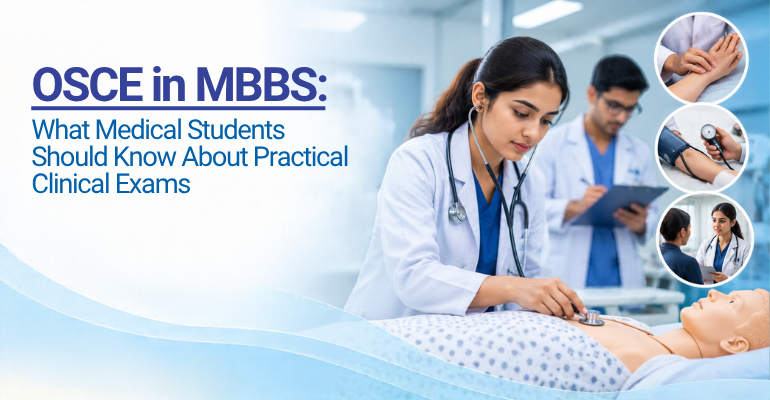
An OSCE is a structured practical assessment designed to evaluate clinical and communication skills through a series of stations. Each station usually focuses on a specific task, allowing students to demonstrate their ability in a controlled and standardized setting.
For MBBS students, understanding how an OSCE works and preparing for it through regular practical practice can make clinical examinations less stressful and more productive.
What Is an OSCE?
OSCE stands for Objective Structured Clinical Examination.
It is a practical examination in which students move through a series of stations. Each station has a specific task, clinical scenario, or skill to complete within a defined period.
Unlike a traditional written examination, an OSCE evaluates what a student can do, not just what they can remember.
Depending on the medical curriculum and institution, students may be asked to:
- Take a focused medical history
- Perform a physical examination
- Demonstrate a clinical procedure
- Interpret laboratory investigations
- Interpret an ECG or imaging study
- Communicate information to a patient
- Explain a treatment or procedure
- Demonstrate professional behaviour
- Identify clinical findings
- Develop an appropriate clinical approach
Students are usually assessed according to predetermined criteria or checklists.
Why Is OSCE Important During MBBS?
A doctor needs both medical knowledge and practical skills.
A student may know the textbook definition of a disease but still need to demonstrate how to take a relevant history, identify important symptoms, examine a patient, interpret findings, and communicate appropriately.
OSCEs help assess these practical competencies.
They can evaluate:
- Clinical examination skills
- History-taking
- Communication
- Procedural skills
- Clinical interpretation
- Patient safety
- Professional behaviour
- Structured clinical thinking
- Ability to follow appropriate clinical steps
This makes OSCE preparation valuable not only for examinations but also for developing habits that are important during clinical postings and future medical practice.
How Does an OSCE Work?
An OSCE usually contains multiple stations arranged in a circuit.
Students receive instructions at each station explaining what they are expected to do. A bell, timer, or other signal may indicate when it is time to move to the next station.
For example, one station may ask a student to take a focused history from a patient with abdominal pain.
Another may require a cardiovascular examination.
A third may involve interpretation of an ECG.
A communication station may ask the student to explain a procedure or provide appropriate health information to a patient.
The exact number of stations, time allotted, marking system, and clinical tasks vary between institutions.
Common Types of OSCE Stations
Understanding different station types can help students prepare systematically.
1. History-Taking Stations
History-taking is one of the most common clinical skills assessed.
Students may be asked to take a focused history for complaints such as:
- Chest pain
- Abdominal pain
- Headache
- Breathlessness
- Fever
- Vomiting
- Cough
- Joint pain
The aim is not to ask every possible question. Students should identify the relevant information, ask questions logically, and respond appropriately to the patient’s answers.
A good history should also include appropriate introductions, consent, patient comfort, and closure.
2. Physical Examination Stations
Students may be required to perform a systematic examination.
Common examples include:
- Cardiovascular examination
- Respiratory examination
- Abdominal examination
- Neurological examination
- Musculoskeletal examination
- Cranial nerve examination
The examiner may assess whether the student follows a logical sequence, uses appropriate technique, communicates with the patient, and recognizes important findings.
3. Procedure Stations
Procedure stations assess whether students understand and can demonstrate clinical skills.
The exact procedures depend on the MBBS curriculum and institution.
Students may be assessed on skills such as:
- Hand hygiene
- Basic life support
- Venepuncture
- Injection technique
- Consent for procedures
- Use of clinical equipment
- Basic emergency procedures
Patient safety should remain a priority during every procedure.
4. Communication Stations
Communication is an essential part of medical practice.
Students may be asked to:
- Explain a procedure
- Obtain informed consent
- Provide health education
- Explain medication instructions
- Communicate information to a patient or relative
- Respond to concerns or questions
The examiner may assess clarity, empathy, professionalism, listening, and the ability to explain information in understandable language.
5. Data Interpretation Stations
Some OSCE stations test clinical interpretation.
Students may receive:
- ECGs
- X-rays
- Blood test results
- Urine reports
- Clinical photographs
- Other investigation findings
The student may need to identify the important abnormality, interpret it, and suggest the appropriate next clinical step.
How Should MBBS Students Prepare for an OSCE?
OSCE preparation is most effective when students practice clinical skills rather than relying only on reading.
Understand the Examination Pattern
Before beginning preparation, students should understand how their institution conducts the examination.
Find out:
- Number of stations
- Time per station
- Types of skills assessed
- Marking criteria
- Clinical subjects included
- Whether stations include standardized patients, mannequins, images, or equipment
Knowing the format helps students plan preparation more efficiently.
Practice Clinical Skills Regularly
Clinical skills improve through repetition.
Reading a textbook can help students understand the steps of an examination, but performing the examination repeatedly is necessary to develop confidence.
Students can practice with classmates during study sessions and clinical postings.
One student can act as the candidate, another as the patient, and another as the examiner.
This creates a practical environment similar to an OSCE.
Use a Systematic Approach
A consistent structure can help students avoid missing important steps.
For many clinical stations, students should develop habits such as:
- Introduce yourself.
- Confirm the patient’s identity.
- Explain what you intend to do.
- Obtain consent.
- Ensure appropriate privacy and comfort.
- Perform the task systematically.
- Communicate appropriately.
- Summarize or explain findings.
- Thank the patient.
The exact approach depends on the station, but developing a consistent structure can reduce unnecessary confusion.
Practice With a Timer
Time management is one of the challenges of an OSCE.
Students may know the correct procedure but lose marks because they spend too much time on one part of the station.
During preparation, use a timer and practice completing common tasks within the expected duration.
The objective is not to rush. Instead, students should learn how to prioritize important steps while maintaining safe and professional practice.
Practice History-Taking
History-taking should be practiced repeatedly.
Instead of memorizing isolated questions, students should understand why particular questions are asked.
For example, when assessing chest pain, students should be able to explore the characteristics of pain, associated symptoms, relevant medical history, risk factors, medication history, and other clinically important information.
The exact questions should be adapted to the patient’s presenting complaint.
Practice Physical Examination Sequences
Students should know the standard sequence of common examinations.
Rather than trying to memorize every detail at the last minute, practice examinations during clinical postings.
Repeated practice helps students become familiar with:
- Patient positioning
- Inspection
- Palpation
- Percussion
- Auscultation
- Special tests
- Interpretation of findings
Students should also learn when certain steps are appropriate rather than mechanically performing every possible maneuver.
Improve Communication Skills
Technical knowledge alone is not enough.
A student can perform a correct examination but still create a poor patient interaction if they fail to explain what they are doing.
During practice, pay attention to:
- Clear introductions
- Appropriate language
- Active listening
- Respectful communication
- Patient comfort
- Consent
- Empathy
- Professional behaviour
Avoid using complicated medical terminology when communicating with patients unless it is necessary and explained clearly.
Use Checklists
Checklists can make OSCE preparation more organized.
For each station, students can create a checklist covering the essential steps.
For example:
- Introduction
- Consent
- Hand hygiene
- Patient positioning
- Examination steps
- Relevant questions
- Findings
- Interpretation
- Closure
The checklist should reflect the requirements of the particular station and the guidance provided by the medical school.
Practice Mock OSCEs
Mock OSCEs are one of the most effective ways to identify gaps in preparation.
A mock examination can include multiple stations completed under realistic time limits.
After each station, students should review:
- What went well?
- Which steps were missed?
- Was the sequence logical?
- Was communication appropriate?
- Was time managed effectively?
- Did the student identify the important findings?
Constructive feedback can help improve performance before the actual examination.
Common OSCE Mistakes
Many OSCE mistakes are avoidable.
Common problems include:
Forgetting to Introduce Yourself
Students sometimes become nervous and immediately begin the task.
A proper introduction establishes professional communication and helps the patient understand who is conducting the examination.
Forgetting Consent
Students should explain the examination or procedure and obtain appropriate consent.
Poor Time Management
Spending too long on one part of a station can leave insufficient time for the remaining tasks.
Ignoring Communication
Students may concentrate so heavily on technical steps that they forget to communicate with the patient.
Losing Confidence After a Mistake
A small mistake does not necessarily mean the entire station is lost.
If you forget a step, remain calm, correct it if possible, and continue systematically.
How to Handle OSCE Anxiety
Practical examinations can be stressful, particularly when students are being observed.
Preparation is one of the best ways to reduce examination anxiety.
Students can also:
- Practice under timed conditions
- Perform mock examinations
- Review commonly assessed skills
- Avoid last-minute cramming
- Get adequate sleep before the examination
- Take a moment to read the station instructions carefully
- Focus on the task rather than worrying about the examiner
During the examination, take a brief moment to organize your approach before beginning.
How Clinical Postings Can Help With OSCE Preparation
Clinical postings provide opportunities to practice skills in real-world settings.
Students can observe how doctors:
- Introduce themselves to patients
- Take histories
- Perform examinations
- Explain procedures
- Communicate diagnoses
- Discuss investigations
- Maintain patient safety
Students should use these experiences to strengthen their practical understanding rather than waiting until examination season.
OSCE Preparation Should Go Beyond the Exam
The purpose of OSCE preparation should not be limited to obtaining marks.
The skills assessed in OSCEs are also relevant to clinical practice.
A doctor needs to communicate effectively, examine patients systematically, recognize important findings, perform procedures safely, and respond appropriately to clinical situations.
Developing these abilities during MBBS can provide a strong foundation for future clinical training.
A Simple OSCE Preparation Strategy
Students looking for a practical preparation plan can divide their preparation into stages.
Stage 1: Identify the Skills
Make a list of clinical examinations, procedures, communication scenarios, and interpretation tasks included in your curriculum.
Stage 2: Learn the Correct Technique
Use reliable textbooks, teaching sessions, demonstrations, and faculty guidance to understand the appropriate method.
Stage 3: Practice
Perform each skill repeatedly with classmates or under faculty supervision where appropriate.
Stage 4: Practice Under Time Pressure
Once comfortable, introduce a time limit.
Stage 5: Take Feedback
Ask peers or teachers to identify missed steps and areas that need improvement.
Stage 6: Perform Mock OSCEs
Complete several stations consecutively to simulate examination conditions.
What Should Students Do on the Day of the OSCE?
On examination day, students should read the instructions carefully before starting each station.
Do not assume that every station requires the same approach.
If the instructions ask for only a specific component of an examination, focus on that task.
Maintain professional behaviour throughout the station and remember basic principles such as consent, patient comfort, hand hygiene, and appropriate communication.
If you make a mistake, do not allow it to affect the rest of the station. Stay composed and continue.
Conclusion
OSCEs are an important practical assessment method in medical education because they allow MBBS students to demonstrate clinical, communication, procedural, and interpretation skills in a structured setting.
Preparing for an OSCE requires more than memorizing textbook information. Students should practice clinical examinations, history-taking, procedures, communication, investigation interpretation, and time management.
Regular practice during clinical postings, peer learning, checklists, mock stations, and constructive feedback can help students become more confident and systematic.
Most importantly, the skills developed through OSCE preparation are not limited to examinations. They form part of the foundation needed for safe, effective, and patient-centred clinical practice.